
Dear Editor,
Venous leg ulcers are the most common cause of chronic wounds in the lower extremities.Venous insufficiency and increased venous pressure are the main contributors to ulcer development.The primary treatment step is restoration of venous function, along with general wound care principles. Surgical interventions, such as skin grafting, can be used to promote wound healing in selected cases. In this letter, we describe a patient treated with the punch grafting technique, a simple procedure that requires little experience and can be performed using basic instruments available in a dermatologic surgery room.
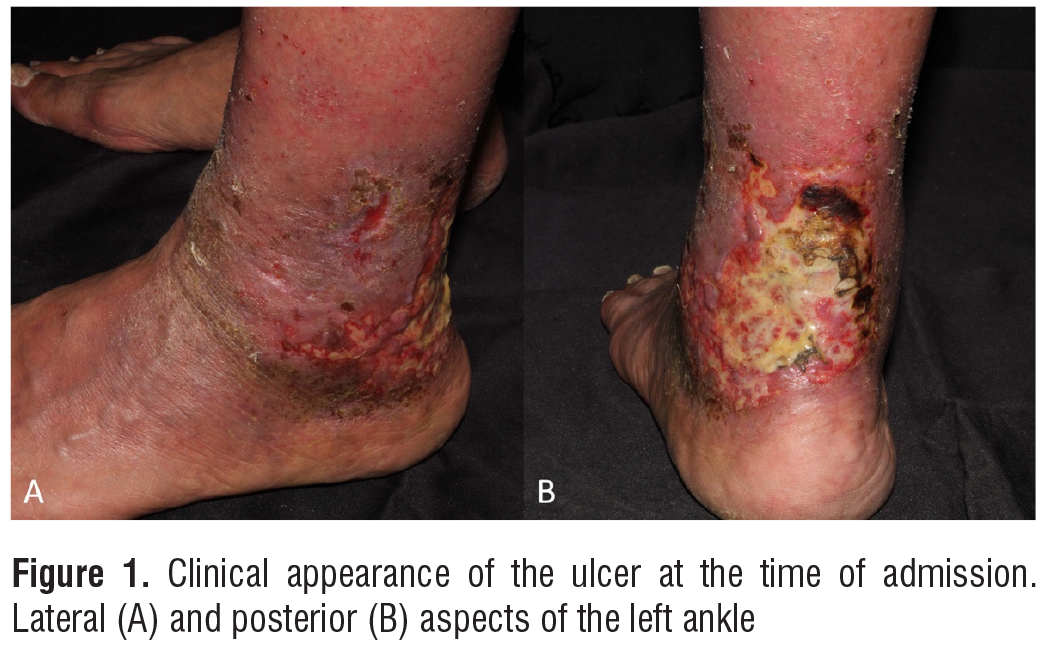
A 63-year-old male patient presented with a six-month history of an oozing, painful, non-healing ulcer with irregular edges and purulent base (, B). The patient had previously used various topical treatments but without any benefit. Pretibial edema, varicose veins, and eczematous dermatitis around the surrounding skin were also noted. Doppler ultrasonography confirmed venous insufficiency. Compression therapy, together with intravenous antibiotics, topical corticosteroids, oral pentoxifylline, and oral diosmin/hesperidin, were initiated. Intermittent mechanical debridement was performed as necessary. In the 2nd week of follow-up, the purulence regressed and the ulcer became vividly red. At this stage, skin grafting was decided to improve recovery. Before the procedure, written informed consent was obtained from the patient.
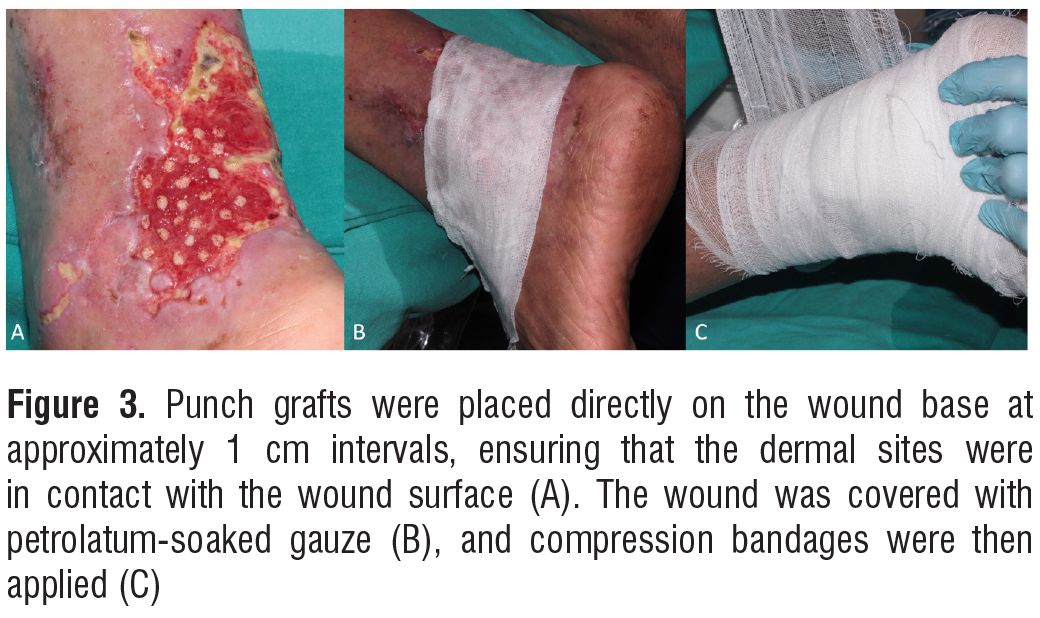
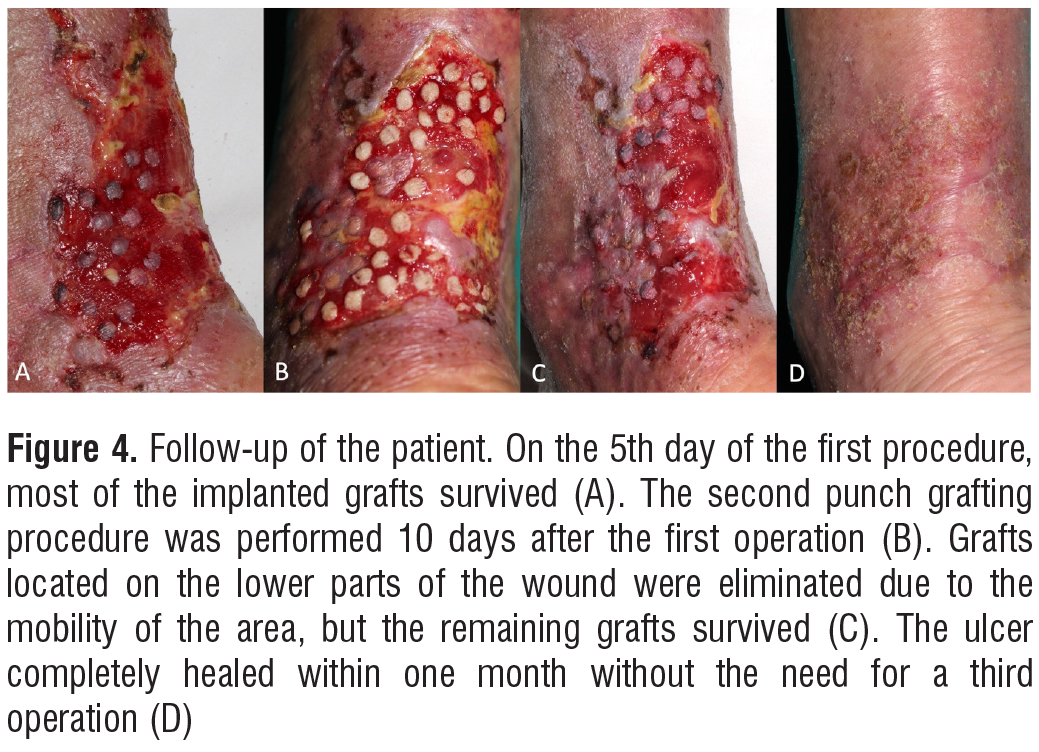
The donor site was selected from the lumbosacral area, and infiltration anesthesia was administered. After anesthesia, approximately thirty incisions were made using a 4 mm punch instrument (). The incisions were superficial enough not to reach the subcutaneous fat. Skin grafts were harvested using forceps and a #15 blade and were collected on gauze soaked in saline (, C). The donor area was then covered with antibiotic ointment and left for secondary healing. The collected grafts were transplanted onto the wound base at 1 cm intervals (). The wound was then covered with petroleum-soaked gauze, and a compression bandage was applied (, C). The patient was instructed to rest and elevate his legs. The first dressing change was done on the 5th day, and it was observed that most of the punch grafts were attached to the wound base (). Ten days after the procedure, the same procedure was repeated for the rest of the wound (). Most grafts survived except those located on the mobile ankle crease (). Compression therapy was continued, and the ulcer healed within 1 month without the necessity of any additional procedures (). No complications occurred in the donor area.
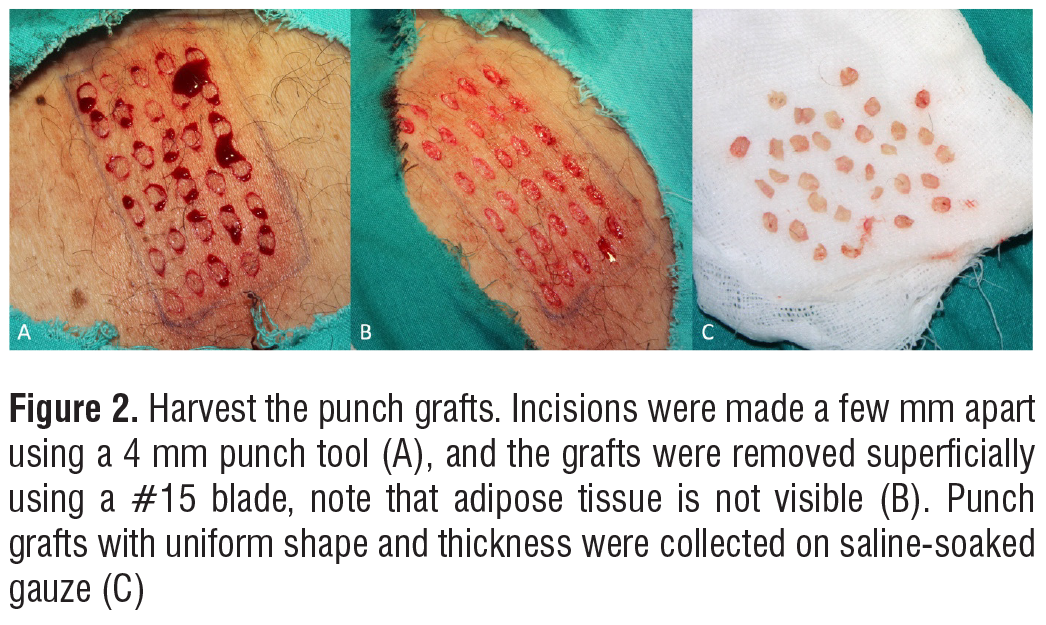
The implantation of small pieces of skin into chronic wounds to accelerate healing was first described by Reverdin in the late 19th century. Reverdin’s original technique involves pinching a piece of skin and then removing it superficially using a surgical blade. Because the grafts obtained in this way have different shapes and thicknesses, they may cause cobblestoneing when healed. Using a punch tool for harvesting produces grafts of uniform shape and thickness. However, if grafts are taken full thickness, including adipose tissue, it is necessary to drill holes in the recipient site for graft survival, which makes the operation more complicated. These difficulties can be overcome by harvesting grafts superficially, as in pinch grafting, after punch incisions are made in the donor area. In this way, many grafts of similar shape and thickness can be quickly taken and placed directly on the wound. As a simple and practical technique, punch grafting can help shorten healing times and reduce pain in patients with leg ulcers.
Footnotes
Ethics
Informed Consent: Written informed consent was obtained from the patient.
Authorship Contributions
Surgical and Medical Practices: O.E., A.S.Ş., F.A., G.A., V.A.E., Concept: O.E., A.S.Ş., Design: O.E., Data Collection or Processing: O.E., A.S.Ş., Analysis or Interpretation: O.E., Literature Search: O.E., A.S.Ş., Writing: O.E., A.S.Ş., F.A., G.A., V.A.E.
Conflict of Interest: The authors declared that they have no conflict of interest.
Financial Disclosure: The authors declared that this study received no financial support.
References
Körber A, Klode J, Al-Benna S, Wax C, Schadendorf D, Steinstraesser L, Dissemond J. Etiology of chronic leg ulcers in 31,619 patients in Germany analyzed by an expert survey. J Dtsch Dermatol Ges. 2011;9:116-121.
Singer AJ, Tassiopoulos A, Kirsner RS. Evaluation and Management of Lower-Extremity Ulcers. N Engl J Med. 2017;377:1559-1567.
Cooper MA, Qazi U, Bass E, Zenilman J, Lazarus G, Valle MF, Malas MB. Medical and surgical treatment of chronic venous ulcers. Semin Vasc Surg. 2015;28:160-164.
Klasen HJ. History of free skin grafting. Knowledge of empiricism?: Springer Science & Business Media; 2012.
Thami GP, Singal A, Bhalla M. Surgical Pearl: full-thickness punch grafting in chronic nonhealing ulcers. J Am Acad Dermatol. 2004;50:99-100.