Dear Editor,
Erythroderma is a serious and potentially life-threatening condition characterised by generalized erythema and scaling covering at least 75-90% of the skin. Here we report on a successful treatment approach for psoriatic erythroderma that involved combining modified wet wrap therapy with oat baths. This novel method proved to have minimal side effects and led to a rapid response, which is particularly noteworthy considering the patient’s age and comorbidities.
A 70-year-old man with a known history of hyperthyroidism and previous prostate cancer diagnosis was admitted to our clinic. He complained of erythema all over his body, along with scaling, chills, and weakness (). After a thorough review of the patient’s medical history, a complete clinical examination, and a histopathological analysis, the patient was admitted to the clinic with a confirmed diagnosis of psoriatic erythroderma. Given the patient’s advanced age and overall health condition, a wet dressing treatment was initiated following an oat bath, with the objective of achieving a rapid improvement. Methotrexate 15 mg/week was initiated as a systemic treatment for the disease and to maintain remission.
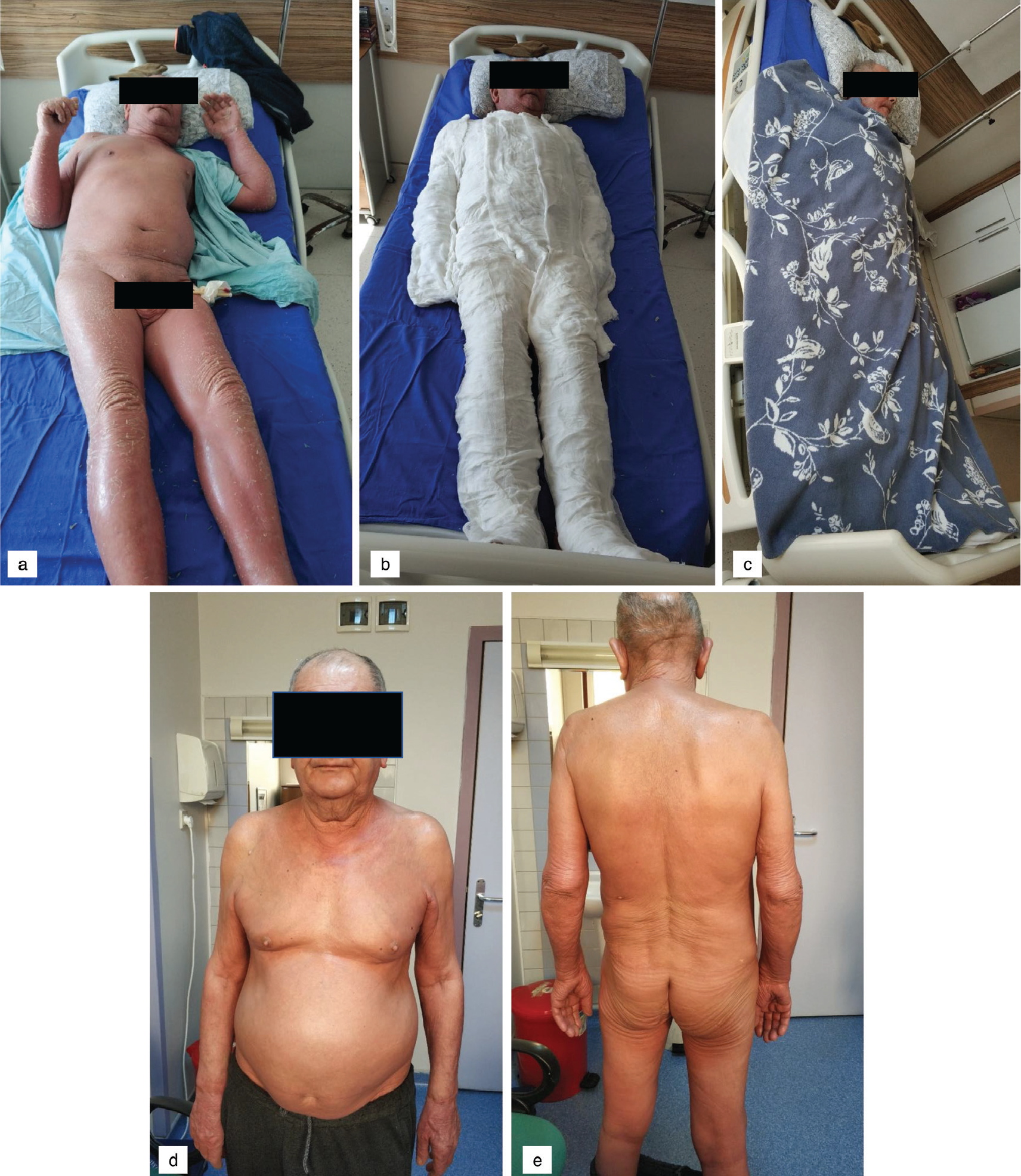
An oat bath was prepared by adding approximately 80 grams of ground oat flour to 120 liters of water. The oat bath was applied to the patient for 15-20 minutes. Afterward, 25 grams of clobetasol propionate was applied to the anterior surface of the body. Subsequently, the anterior surface of the body was covered with large cloths moistened with warm water and then overlaid with a blanket. Following a two-hour application period, a similar procedure was repeated on the posterior surface of the trunk (, ). The treatment was administered for a total of four consecutive days. The patient’s complaints of erythema, scaling, chills, and laboratory values improved significantly by the end of the four-day treatment period (, ).
In our clinic, we successfully employed an oat bath and modified wet wrap treatment in a case of psoriatic erythroderma, which we developed based on our previous experiences. Wet wrap therapy has been classically described as a salvage treatment option for atopic dermatitis. Its ability to successfully treat patients with psoriasis has been shown over time. Similar to our approach, there is only one study in the literature that has explored the use of wet wrap treatment in patients with psoriatic erythroderma. The summarises the classic wet wrap treatment for atopic dermatitis and psoriatic erythroderma., Our methodology differs from the studies on atopic dermatitis and psoriasis in two important ways. First, we have modified the wet wrap treatment. Second, we have combined it with oat baths. With the oat bath, we aimed to enhance the effect of topical corticosteroid treatment by increasing its absorption and to benefit from the anti-inflammatory, antioxidant, moisturising, cleansing and soothing effects of oats. Consequently, while the literature indicates longer application times for the wet wrap treatment, our preference is a 2-hour application. Patients with psoriatic erythroderma should begin systemic treatment promptly to achieve long-term disease control. Once the modified wet dressing treatment was completed, we commenced methotrexate therapy at 15 mg per week. The patient was followed up for 3 months, and no additional flare-ups were observed during the monthly examinations.
Table 1. Wet Wrap Therapy Methods in the literature
Study/indication | Bathing | Wet wrapping | Application frequency/duration |
Devillers and Oranje2/atopic dermatitis | 5-10 minutes with warm water before application | Diluted fluticasone propionate 0.05% is used. The first layer is a bandage soaked in warm water and the second layer is a dry bandage. The dressings are remoistened every 2-3 hours. | 1 time a day, for 3-24 hours. Maximum 3-4 consecutive days in total. |
Navrotski et al.3/erythrodermic psoriasis | - | After applying medium-high strength corticosteroid (betamethasone dipropionate 0.05% or clobetasol dipropionate 0.05%) to all affected surfaces, first layer is formed with a warm moist cotton cloth and second layer with a dry cotton cloth. The patient is wrapped with a blanket to minimise heat loss. | 2-4 times a day for 1 hour. In total 2-5 times a week. |
Our study | Oat bath 15-20 minutes | After applying clobetasol dipropionate 0.05% cream to all affected areas, first layer is formed with a warm damp cotton cloth and second layer with a dry cotton cloth. The patient is wrapped in a blanket to minimise heat loss. | 1 time a day for 2 hours. 4 consecutive days in total. |
In conclusion, the oat bath and modified wet dressing treatment, used for the first time in our clinic with Antalya approach, may be preferred as an alternative to systemic treatment and as a salvage treatment, especially in elderly psoriatic erythroderma patients with comorbidities. Further similar observations on this topic will provide more objective information on the efficacy of this new method.
Footnotes
Conflict of Interest: The authors declared that they have no conflict of interest.
Financial Disclosure: The authors declared that this study received no financial support.
References
Lo Y, Tsai TF. Updates on the treatment of erythrodermic psoriasis. Psoriasis (Auckl). 2021;11:59-73.
Devillers AC, Oranje AP. Efficacy and safety of ‘wet-wrap’ dressings as an intervention treatment in children with severe and/or refractory atopic dermatitis: a critical review of the literature. Br J Dermatol. 2006;154:579-585.
Navrotski BRF, Nihi FM, Camilleri MJ, Cerci FB. Wet wrap dressings as a rescue therapy option for erythrodermic psoriasis. An Bras Dermatol. 2018;93:598-600.
Pazyar N, Yaghoobi R, Kazerouni A, Feily A. Oatmeal in dermatology: a brief review. Indian J Dermatol Venereol Leprol. 2012;78:142-145.